








Local governments across Japan are ramping up efforts to attract digital nomads as part of a broader push to promote longer and more sustainable stays. This comes amid rising concerns over overtourism affecting major Japanese cities such as Kyoto and Tokyo since the COVID-19 pandemic.
“More local governments want digital nomads because they can stay longer than normal tourists,” Ryo Osera, an executive member of the Japan Digital Nomad Association (JDNA), told the South China Morning Post in a recent interview. “They can also spend lots of money because they [tend to] have high-skilled, professional careers.”
Established in 2022, the JDNA aims to make Japan more welcoming for digital nomads. One of its main initiatives at the moment is to expand Japan’s Digital Nomad Visa program, which currently allows a maximum stay of six months. This duration pales in comparison with other locations like Portugal, Malta, and Dubai, which offer stays for up to one year.

Japan officially launched its Digital Nomad Visa scheme in March 2024. The visa permits holders to live and work remotely from Japan for up to six months, and includes special provisions for accompanying spouses and children.
To apply, applicants must prove that they work remotely for a company or clients outside Japan, and must submit documents about their job, income, and plans during their stay in Japan.
This includes producing documents proving that their annual income is JPY 10 million (US$65,000) or more, such as tax payment certificate, income certificate, employment contract, or contract with a business partner.
They must also present either a detailed stay plan during their stay in Japan, or produce a Certificate of Eligibility issued by a regional immigration bureau.
Finally, they must carry insurance covering death, injury, or illness during their stay, with a minimum medical coverage of JPY 10 million.
Accompanying spouses and children must produce the same documents.
The Digital Nomad Visa cannot be extended and doesn’t come with a residence card. This means that visaholders cannot open a Japanese bank account, sign long-term rental contracts, or register at a city hall. The same restrictions apply to accompanying spouses and children.
Furthermore, the visa is limited to nationals and citizens from a little over 50 countries that have both a visa waiver and a tax treaty with Japan. These countries include most of Europe, North America, as well as the United Arab Emirates (UAE), Qatar, Singapore, Taiwan, Indonesia, and Hong Kong. Spouses and children from over 20 additional countries may also apply, but only as dependents.
Japan: one of the world’s hottest travel destinations
Unlike typical tourists who visit briefly and concentrate their spending in high-traffic tourist zones, digital nomads tend to rent local housing, frequent neighborhood businesses, and integrate into communities. This creates steady incomes for small businesses and helps diversify the local economy beyond seasonal tourism.
Furthermore, digital nomads often choose housing in less touristy areas where they can live and work quietly. This slower and more integrated lifestyle usually aligns better with sustainable development and avoids the short-term strain that mass tourist brings.
Over the past five years, Japan has grown into one of the world’s hottest travel destinations. The country was voted the number one country in the world by the readers of Condé Nast Traveler in the magazine’s 2025 Readers’ Choice Awards for the third consecutive year. Tokyo (#1) and Kyoto (#2) was voted the top two best “Large Cities” in the world, with Tokyo leading the list for the second year in a row.
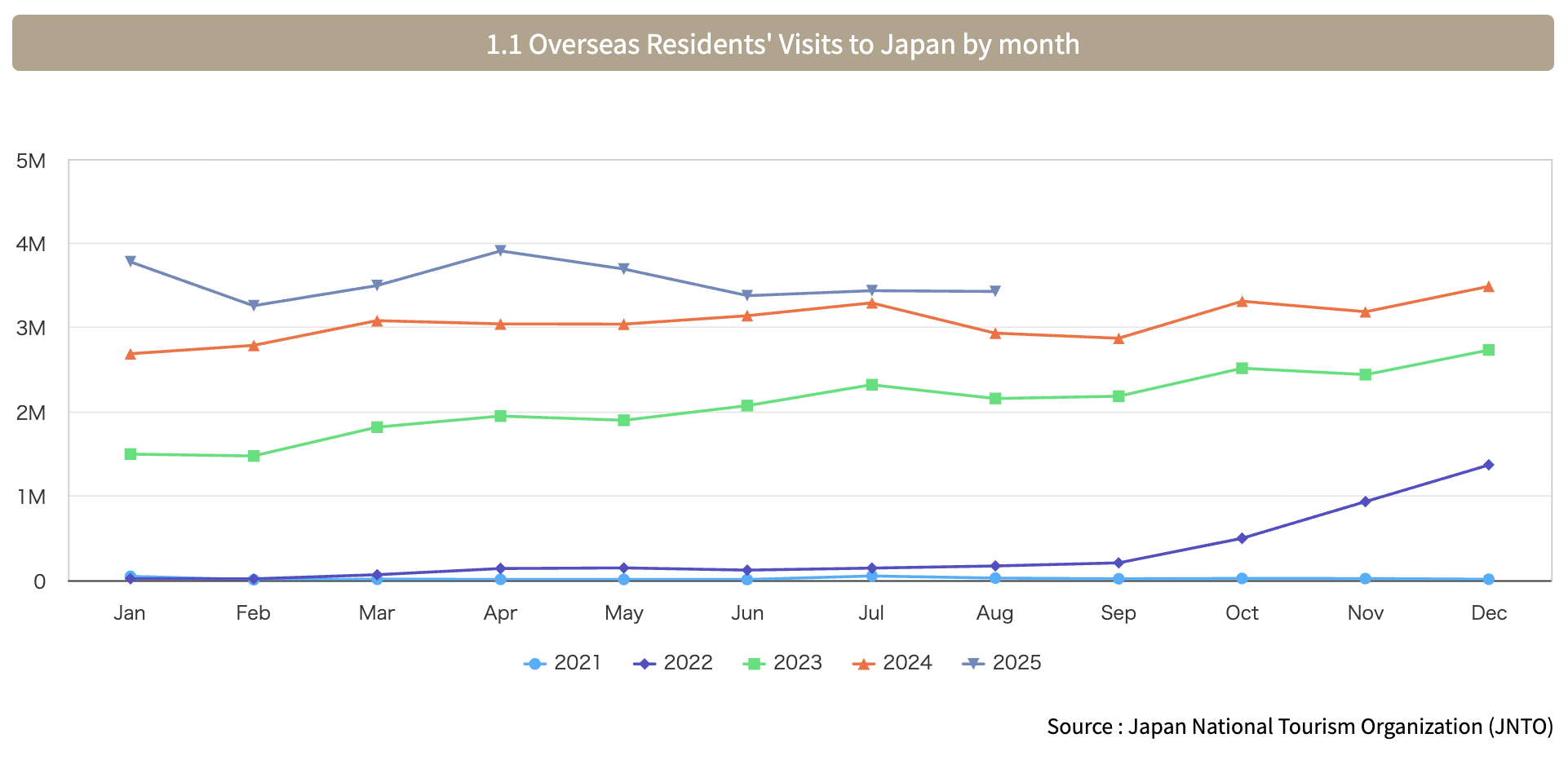
Between January and August 2025, more than 28 million foreign visitors arrived in the country, marking a 17% increase from about 24 million a year prior, according to Japan National Tourism Organization (JNTO). The estimated number of international travelers to Japan in August 2025 was 3,428,000, representing a 16.9% year-over-year (YoY) increase.
Breaking down the number of foreign visitors to Japan in August 2025 by country and region, China ranked first with 1,018,600 visitors in August 2025, followed by South Korea with 660,900 visitors, and Taiwan with 620,700 visitors.
Overtourism in Japan
This surge in international tourism has led to made inbound travel a key pillar of Japan’s economy. Inbound tourism is now the country’s second-largest export sector behind automobiles, with spending by foreign visitors reaching an annualized JPY 7.2 trillion (US$47 billion) for the period between January and March 2024.
However, this rapid increase in tourism has also led to highly concentrated tourism in a handful of prefectures. This over-concentration of tourists has negatively impacted residents’ daily lives, leading to issues including congestion, overcrowded transport, noise pollution, and waste management.
To address these challenges, Japanese lawmakers are currently considering hiking the departure tax from JPY 1,000 (US$6.5) per person to JPY 3,000 yen (US$20), NHK, the Japan Broadcasting Corporation, reported earlier this week.
Introduced in 2019, the departure tax, formally called the International Tourist Tax, is levied on all travelers leaving Japan, including Japanese citizens. It’s collected as a fee added to the prices of tickets for airlines and other forms of transportation.
Some members of the Japanese government and ruling party have proposed that increased revenue from the tax hike be used to address the challenges caused by overtourism, such as transportation congestion and disruptive behavior by some foreign tourists.
Lawmakers are expected to begin discussions on the tax reform in fiscal 2026 with the focus on whether the tax should be raised and by how much.
Japan is one of the many countries in Asia to have introduced a special visa scheme for digital nomads and remote workers, joining Thailand, Indonesia, and South Korea, among others.
Featured image by tawatchai07 on Freepik
